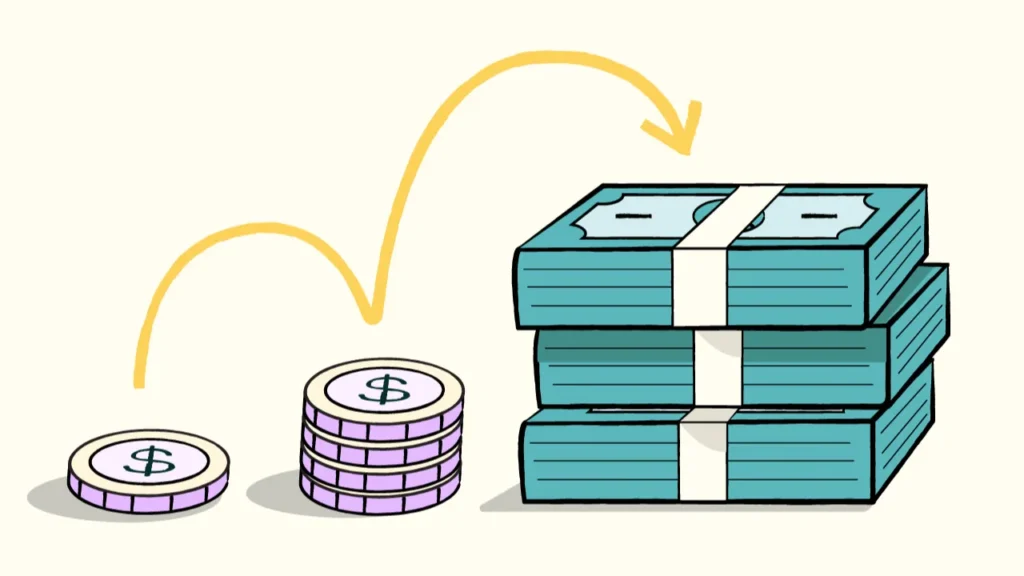
Most people believe you need a huge amount of money to become rich. But what if the real secret to wealth isn’t how much you invest — but how early and how consistently you start?
That’s the magic of compound interest, one of the most powerful financial forces in the world. Let’s break it down so you can start using it to your advantage — even with just a few dollars.
1. What Is Compound Interest?

In simple terms, compound interest means earning interest on your interest.
It’s when your money grows because both your original investment and your previous earnings start generating more income over time.
For example:
If you invest $100 at a 10% annual return, after one year you’ll have $110.
In the second year, you’ll earn 10% on $110, not $100 — meaning $11 in interest instead of $10.
That extra dollar may seem small, but over time, it becomes massive.
2. Why Compound Interest Is Called the “8th Wonder of the World”
Albert Einstein allegedly called compound interest “the eighth wonder of the world.”
Why? Because it allows small amounts to grow into large fortunes — if you give them enough time.
Let’s say you invest $100 every month starting at age 25 with a 7% annual return.
By age 65, you’d have over $240,000 — and you only contributed $48,000 of your own money.
That’s the power of time and compounding combined.
3. The Secret Ingredient: Time
The earlier you start, the more powerful compound interest becomes.
Even small investments can explode over decades because your returns keep building on themselves.
Consider this comparison:
- Investor A: starts at age 25, invests $100/month for 10 years, then stops.
- Investor B: starts at age 35, invests $100/month until age 65.
Who ends up with more?
Investor A wins, despite investing for only 10 years — simply because their money had 10 more years to grow.
Time is the real multiplier of wealth.
4. You Don’t Need Thousands to Start
Thanks to modern investing platforms, you can begin with very little money.
Apps like Acorns, Robinhood, or Fidelity let you invest with just $5 or $10.
You can even buy fractional shares, meaning you own small parts of expensive stocks like Apple or Amazon.
The point is: start now, not when you “feel ready.”
5. How to Make Compound Interest Work for You
Here’s a simple roadmap to start leveraging compound interest — no financial degree required:
Step 1: Save Before You Spend
Set up an automatic transfer into your investment account every time you get paid.
Step 2: Choose Low-Cost Investments
Look for index funds or ETFs with low fees. They give you broad market exposure and steady growth over time.
Step 3: Reinvest Your Earnings
Never withdraw your gains early. Reinvest all dividends and profits to maximize compounding.
Step 4: Be Consistent
Even if it’s only $25 or $50 a month, keep going. The habit matters more than the amount.
6. How Compound Interest Works in Real Numbers
Let’s visualize it with a quick example:
| Monthly Investment | Annual Return | Years | Final Balance |
|---|---|---|---|
| $50 | 7% | 30 | $61,500 |
| $100 | 7% | 30 | $123,000 |
| $200 | 7% | 30 | $246,000 |
Notice how doubling your contribution doesn’t just double your outcome — it multiplies it faster because of compounding.
7. Avoid These Mistakes That Kill Compounding
Even small missteps can slow your growth. Avoid these common traps:
- Withdrawing early — interrupts your compounding process.
- High fees or commissions — eat into your returns.
- Chasing short-term profits — stay focused on long-term growth.
Wealth is built by patience, not by luck or timing the market.
8. Use Compound Interest Beyond Investing
Compound interest doesn’t only apply to investments — it works in other areas too:
- Career: Every new skill compounds your earning potential.
- Health: Daily good habits build stronger long-term results.
- Relationships: Small, consistent efforts create deeper trust and value.
Think of compounding as a universal principle — what you repeat, grows.
Frequently Asked Questions (FAQs)
1. Can I build wealth with compound interest if I only invest $20 a month?
Yes. The key is consistency and time. Even $20 monthly can grow into thousands over decades.
2. What type of account should I use for compound interest?
Consider tax-advantaged accounts like 401(k)s or IRAs, or regular brokerage accounts for flexibility.
3. How often should I check my investments?
Once a month or once a quarter is enough. Avoid daily checking — it leads to emotional decisions.
4. What if I start late?
Start anyway. You can still benefit by investing more aggressively or increasing your monthly contribution.
Conclusion: Start Small, Think Long-Term
Compound interest rewards those who begin early and stay patient.
You don’t need to be rich to get started — you just need to start.
Every dollar you invest is a seed that grows exponentially over time.
So plant your first one today, let time do its magic, and watch how compound interest can make you rich — even with small investments.